Starting Jiu-Jitsu After 40 | Vanguard Academy Long Island
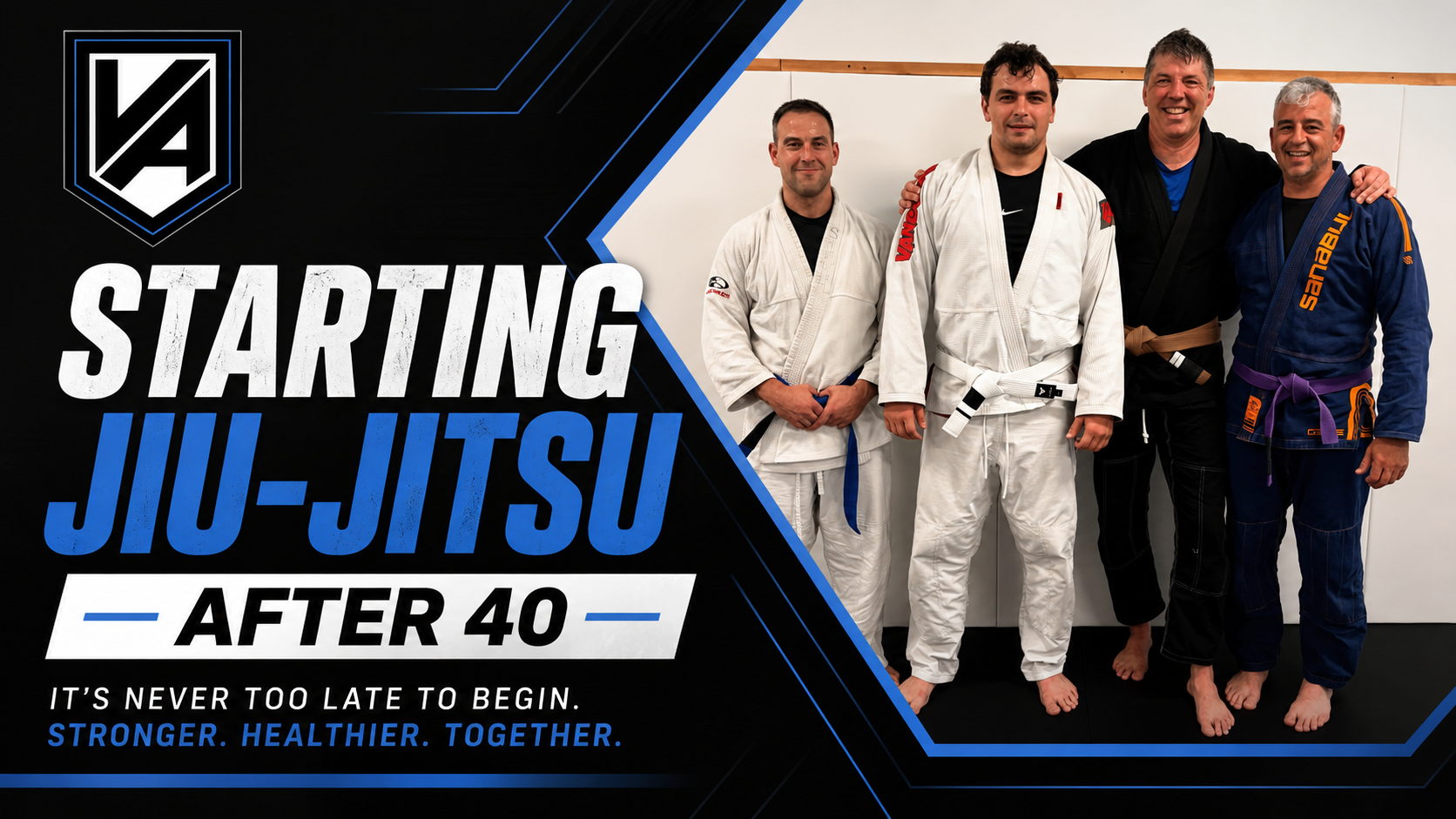
You're Not Too Old to Start Jiu-Jitsu. You're Just Picturing the Wrong Room.
Ask a 43-year-old why he hasn't tried jiu-jitsu and you'll get some version of the same answer.
"I'd get destroyed."
"My back is already shot."
"I'd be the oldest guy there by fifteen years."
Every one of those sentences is describing a room he has never actually walked into. He's picturing a scene from a highlight reel. Twenty-two-year-old athletes going full speed, somebody getting slammed, a guy limping to the parking lot.
That room exists. It's just not the room a beginner walks into.
And here's the part that surprises people. The adult who starts jiu-jitsu at 40, 45, or 55 usually gets more out of it than the kid who started at 19. Not because the training is easier. Because of what a person that age actually needs.
The Real Reason Most Adults Never Start
It isn't the injuries. It isn't the schedule.
It's the fear of being bad at something in front of other people.
At 20, being a beginner is your default state. You're bad at your job, bad at cooking, bad at relationships, and nobody expects otherwise. By 40 you've spent two decades building a life where you're competent. You know how to do your job. You know how to run your household. Being visibly, obviously terrible at something, in a room full of strangers, in a t-shirt, is a feeling most adults have not touched in a very long time.
So the brain finds a more respectable excuse. My knees. My schedule. Maybe next year.
That's the actual barrier. Not the sport.
The good news is the discomfort has a short shelf life. Two or three weeks in, nobody is thinking about you at all, because everyone on the mat is busy getting beat up by somebody. Jiu-jitsu is the rare room where being new is completely unremarkable. Every single black belt in the building was once the confused guy in the corner not knowing where to put his hands.
What Actually Happens to a 45-Year-Old on Day One
Not a spar. Not a fight.
You learn how to fall down without hurting yourself. You learn a shrimp, which is a hip escape, which is the single most useful movement in the entire sport. You drill one position with a partner who is going roughly twenty percent speed and who has been told, explicitly, to take care of you.
You'll be winded. Almost everyone is. Jiu-jitsu uses muscles that treadmills and dumbbells never touch, and your breathing will be the first thing to fail. That's not a fitness verdict. That's a first-day universal.
You will probably not roll live at all in your first class. When you do start rolling, it's with people your size and your experience level, at the pace the coach sets. Nobody hands a 45-year-old white belt to the 24-year-old competitor and says have fun.
If you want the full walkthrough of the logistics, we wrote a separate piece on what to expect on your first day.
The Injury Question, Answered Honestly
We're not going to tell you jiu-jitsu is risk-free. It's a contact sport. People get sore. People occasionally get hurt.
Here's the honest framing.
Almost every injury a 40-plus beginner sustains comes from one of three things, and all three are controllable.
Ego. Refusing to tap because the guy on top of you is younger. This is the number one cause of injury in adult beginners, full stop. A tap costs you nothing. A torn elbow costs you eight months.
Going too hard, too early. Treating a Tuesday night class like a tournament final. Your connective tissue adapts slower than your enthusiasm does.
Bad training partners. Which is a gym problem, not an age problem. If the culture in the room rewards smashing beginners, you will get hurt no matter how old you are.
Now flip it around. Consider the injury risk of the alternative. A sedentary 50-year-old is on a much clearer path to a bad outcome than a 50-year-old who trains twice a week, moves through full ranges of motion, and builds real strength in his hips, grip, and spine. Jiu-jitsu is one of the few activities that trains balance, coordination, and getting up off the floor. Those are the exact capacities that quietly disappear in midlife and that determine how someone's seventies go.
The risk isn't zero. It's just far smaller than the risk of doing nothing, and you have significant control over it.
Why the Room Matters More Than the Technique
This is the part most gyms won't tell you, so we will.
The techniques are basically the same everywhere. Armbar is an armbar. What separates a good experience from a bad one is who is standing next to you.
If you're 47 and your only option is a 6 PM class packed with college wrestlers and competition-team athletes, you're going to have a rough time. Not because you're old. Because the intensity in that room is calibrated for somebody else.
That's exactly why we run a Gi class for ages 40 and up at our Lake Grove location, Monday and Wednesday nights at 7:15. Same instruction, same black belt coaching, same curriculum. Different room. Everybody in it has a job, a mortgage, some accumulated mileage, and a shared understanding that we all have to work in the morning.
That single detail changes everything about how a beginner over 40 experiences the sport. You can look at the full schedule for both locations to see how it fits your week.
We also run 6 AM classes, late morning classes at 10 and 11, and open mats on the weekend. Because the 40-plus crowd's real enemy is usually the calendar, not the mat.
What You Get That the 22-Year-Olds Don't
Younger training partners will out-athlete you. That's just true. Here's what you have that they don't.
You actually need it. A 22-year-old is already strong, already flexible, already sleeping eight hours. Adding jiu-jitsu is a nice bonus. At 45, jiu-jitsu is often the thing that reverses a decade of drift. The delta is enormous. Grip strength comes back. Hips loosen. Weight moves. Sleep improves, because it's hard to lie awake worrying about a work email after an hour of somebody trying to strangle you.
You have patience. Jiu-jitsu punishes people who want fast results and rewards people who show up consistently for years. That is a middle-aged superpower. Young guys quit when progress stalls. Adults who've built a career already understand what a plateau is.
You learn faster than you think. Not physically. Conceptually. Jiu-jitsu is a problem-solving sport, and an adult who has spent twenty years solving problems for a living tends to grasp the why behind a position much quicker than a teenager who's just copying shapes.
You get the thing you're actually missing. Most adults over 40 aren't short on exercise options. They're short on a room full of people who notice when they don't show up. Jiu-jitsu gyms produce that almost by accident, because you cannot train this sport alone. You need partners. Partners become friends. That's a real answer to a real midlife problem, and no treadmill has ever provided it.
And if you're a parent, there's a version of this that matters even more. Kids who see a parent be a beginner at something hard, and stick with it anyway, learn something that no lecture will teach them.
The Ego Thing
You are going to get tapped by people much younger, much smaller, and much less impressive-looking than you. In week one. In week fifty.
You will get submitted by a 130-pound woman who has trained for three years, and it will not be close, because technique and leverage beat size and that is the entire point of the art.
The adults who last in this sport are the ones who decide early that getting tapped is just information. It's the feedback loop. It's how you find the hole in your game. The ones who quit are the ones who need to win a Tuesday night training round to feel okay about themselves.
Once you get past that, the whole thing opens up. There's a specific kind of freedom in being a grown adult who is comfortable being bad at something in public. It bleeds into the rest of your life in ways that are hard to explain until it happens.
Frequently Asked Questions
Am I too old to start jiu-jitsu? No. People start at 40, 50, and 60 regularly and train for decades. The relevant question is not your age but whether the gym has an environment and a schedule built for adults with jobs and families.
Do I need to be in shape first? No, and waiting until you're in shape is how most people never start. Jiu-jitsu conditioning is specific to jiu-jitsu, so you build it by training. Fundamentals classes are paced for people arriving with zero background.
What if I have an old injury? Tell your coach before class. Bad knee, bad back, bad shoulder, previous surgery. Good instructors adjust drills and pair you with the right partner. Most gyms have people training around long-term injuries. It's routine, not an obstacle.
Gi or no-gi for a beginner over 40? Either works. Gi tends to be slower and more methodical, which many older beginners prefer while learning. No-gi is faster and more athletic. Vanguard runs both, and our 40-plus class is gi.
How many days a week do I need to train? Two is enough to make real progress. Three is where it starts moving quickly. One is enough to stay connected but progress will be slow.
Will I get hurt? It's a contact sport, so soreness is guaranteed and some risk exists. The largest controllable factor is your own willingness to tap early and often. Beginners who tap without ego rarely get seriously hurt.
The Real Question to Ask Yourself
Forget whether you're too old. That question has an answer and the answer is no.
Ask this instead. In five years, do you want to be someone who is measurably stronger, calmer, better conditioned, and in possession of a skill most people never acquire? Or do you want to be five years further along the drift you're already on?
Because those are the two options. There isn't a third one where you stay exactly as you are.
The 40-year-old who starts today is a blue belt at 43 with a training partner group and a body that works. The 40-year-old who waits is 45, still thinking about it, and now genuinely does have a harder road.
Come Try It
Your first class at Vanguard is free. No commitment, no sales pressure, no obligation to get on the mat if you'd rather just watch.
You'll train under black belts from the Matt Serra and John Danaher lineage, including instructors who trained in the Blue Basement at Renzo Gracie Academy and a UFC fighter who runs our kickboxing program. Serious credentials, ordinary people, no attitude in the room.
Two Long Island locations:
Lake Grove: 2758 Middle Country Road, Suite 206, Lake Grove, NY 11755. Call 631-615-2974. Commack: 6500 Jericho Turnpike, Commack, NY 11725. Call 631-623-6418.
If the 40-plus class is what you've been waiting for, it runs Monday and Wednesday at 7:15 PM in Lake Grove. Show up ten minutes early in shorts and a t-shirt, bring water, and find out what the room is actually like.
Keep Reading
The Best Martial Art For Women
Why Brazilian Jiu-Jitsu is the most practical self-defense training for women facing real-world threats.
Your First Day at Vanguard Academy: What to Expect on the Mat
Everything you need to know before stepping into your first Brazilian Jiu-Jitsu class at Vanguard Academy — what to wear, what to expect, and how to make the most of your first day.
Why Jiu-Jitsu Builds Tougher, More Confident Kids Than Any Other Martial Art
Most martial arts give kids false confidence. Jiu-jitsu teaches them to stay calm under real pressure. Here's why that matters for life.