Jiu-Jitsu Belts Explained: How Long Each Belt Really Takes
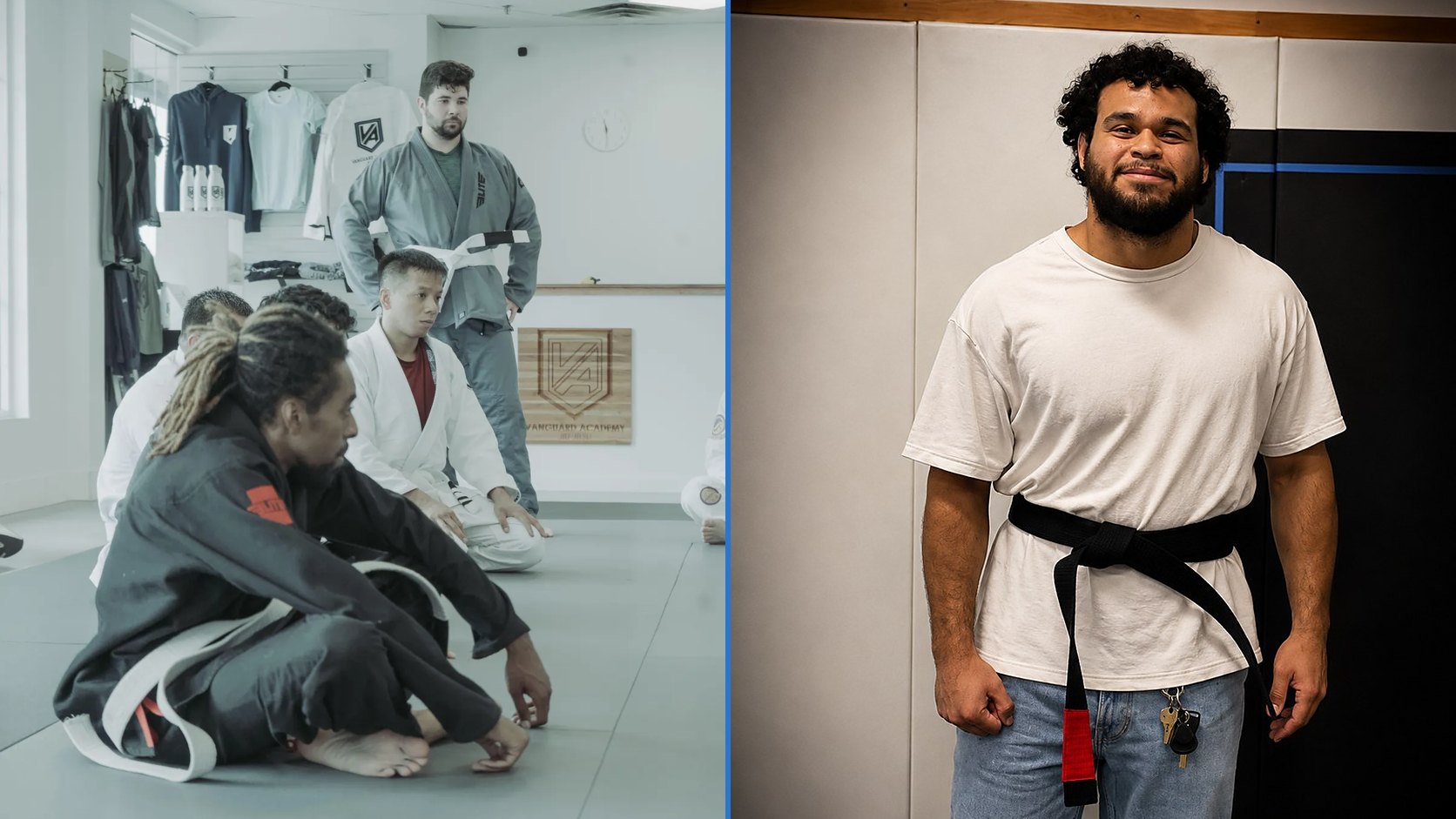
"How long until I get my blue belt?"
Somebody asks it in their first month, every time. Usually quietly, after class, like it's a dumb question.
It's not a dumb question. It just gets a bad answer. "It depends" is true, and it's also useless when you're trying to figure out what you're signing up for.
So here's the real version. Every belt in order, for adults and for kids. The official rules, which almost nobody quotes correctly. What each belt actually means on the mat. And roughly how long each one takes for a normal person with a job, a family, and two or three classes a week.
The Short Version
Adults have five belts. White, blue, purple, brown, black. Every belt below black can carry up to four stripes, which are smaller promotions along the way.
Kids under 16 have their own ladder of 13 belts: white, then grey, yellow, orange, and green, each in three versions. At 16, kids move into the adult belts.
For most adults who train consistently, blue belt takes somewhere between one and three years. Black belt usually takes 8 to 12. The official minimum times add up to far less than that, and almost nobody gets anywhere near the minimum.
The Official Rules (Which Most People Get Wrong)
The International Brazilian Jiu-Jitsu Federation (IBJJF) publishes the belt rules most academies follow. Its graduation system was last updated in June 2026, and it sets minimum ages and minimum times. Not requirements. Your coach decides when you're ready. The IBJJF only sets the floor.
Here's the adult floor, next to what it usually takes in real life.
| Belt | Minimum age | Official minimum time at this belt | What it usually takes* |
|---|---|---|---|
| White | Any age | None | 1 to 3 years |
| Blue | 16 | 2 years | 2 to 3 years |
| Purple | 16 | 1.5 years | 1.5 to 3 years |
| Brown | 18 | 1 year | 1 to 2 years |
| Black | 19 for nearly everyone | Six degrees, the first after 3 years | 8 to 12 years from day one |
*Typical ranges for adults training two or three times a week. Not an official standard.
A few things jump out.
White belt has no minimum. On paper you could get your blue belt in month one. In practice nobody does, because what a blue belt represents takes time to build.
The black belt minimum age is 19. The 2026 rules allow 18, but only for someone who has won the Adult World Championship at brown belt. For the rest of us, it's 19.
The minimums add up to four and a half years after blue. Two at blue, a year and a half at purple, one at brown. Add even a fast white belt and you're past five. Most people take about twice that.
What Each Belt Actually Means
Times are only half of it. Here's what a coach is actually looking at.
White Belt: Learn to Survive
White belt is about not drowning. You're learning the positions, mount, guard, side control, the back, and how to escape the bad ones. You're learning to tap early and keep breathing when someone heavier is on top of you.
You'll spend a lot of your first year on the bottom, and that's on purpose. The escapes you learn as a white belt are the foundation everything else sits on. Our first day guide covers what the very beginning looks like.
Blue Belt: You Have a Defense
A blue belt can handle an untrained person and hold their own against most people their size. They know the positions cold, they don't panic on the bottom, and they have a handful of attacks they can land on people who are resisting.
Blue is also the belt where a lot of people quit. There's even a name for it: the blue belt blues. The excitement of being new is gone, the next belt is years away, and the white belts you used to tap are suddenly catching up. If you know it's coming, it's a lot easier to train through.
Purple Belt: You Have a Game
Purple is where people stop being good at jiu-jitsu in general and start being good at their jiu-jitsu. They have a style. Favorite positions, a path they're always trying to get to, attacks that chain into each other. A lot of purple belts start helping teach, too.
Brown Belt: Closing the Holes
Brown belt is finishing school. The game is built. Now it's about tightening it, filling the gaps, and making it work against anybody, any size, from any position. Brown belts tend to be calm, efficient, and very hard to do anything to.
Black Belt: Starting Over, Properly
Ask black belts what it felt like and a lot of them say the same thing. It felt like the beginning. The black belt means you've learned the whole language. What you say with it is up to you.
The black belt has six degrees of its own, the first after at least three years. After that come the red-and-black belt (7th degree, minimum age 49), the red-and-white belt (8th degree, minimum age 56), and the red belt (9th degree, minimum age 66). Those belong to people who have given their whole lives to the art.
What Are Stripes?
Stripes are the small bars of tape on the black section of a belt. Each belt below black can carry up to four. The IBJJF leaves stripes entirely up to the professor, so every academy handles them a little differently.
Think of a stripe as your coach saying "I see it." It's a checkpoint between belts that can be years apart. A first stripe as a white belt usually means you've been showing up and the basics are starting to stick.
Here's the advice nobody follows. Don't count them. People who train to collect stripes end up frustrated. People who train to get better end up with stripes.
The Kids Belt System
Kids under 16 have a separate ladder built around age, because a 7-year-old and a 15-year-old who have both trained for two years are in very different places.
| Belt group | Belts in the group | Minimum age |
|---|---|---|
| White | White | Any age |
| Grey | Grey-white, grey, grey-black | 4 |
| Yellow | Yellow-white, yellow, yellow-black | 7 |
| Orange | Orange-white, orange, orange-black | 10 |
| Green | Green-white, green, green-black | 13 |
Two things every parent should know.
There's no minimum time at any kids belt. Kids move up when they're ready. The IBJJF suggests a few stripe schedules, monthly, quarterly, or three times a year, and leaves the choice to each academy. Ask your kid's coach how it works in their class.
At 16, kids switch to the adult belts. A grey, yellow, or orange belt becomes a blue belt. A green belt becomes blue, or purple if the coach decides they're ready. A kid who's still a white belt stays white. So a teenager who started at five can walk into the adult room at 16 already wearing purple. That's one of the best arguments for starting young, which we covered in what age kids should start jiu-jitsu.
How Do Coaches Decide When You're Ready?
In most jiu-jitsu academies there's no belt test. No forms, no board breaking, no testing fee to move up. Your coach watches you train, week after week, and promotes you when what you do in live rounds against resisting people matches what the next belt means.
That's why jiu-jitsu belts take so long, and it's why they mean something. In a lot of martial arts, a belt is a record of what you've memorized. In jiu-jitsu, it's a record of what you can actually do to someone who's trying to stop you. You get tested every time you roll.
It's the same reason we tell parents that jiu-jitsu builds real confidence in kids instead of costume confidence. You can't fake a stripe on a mat where everyone can see you roll.
Coaches usually weigh a few things:
- What you can do in live training, against people your size and your experience level.
- How consistently you show up. Two classes a week for a year beats five a week for a month.
- How you train. Are you a good partner? Do you help newer people? Can you go hard without hurting anybody?
- What you understand. Not just whether a move works, but why it works.
Competing can help, because it shows how your jiu-jitsu holds up under pressure. But in most academies you don't have to compete to get promoted, and plenty of black belts never have.
What Actually Decides How Fast You Progress
Not talent. Not athleticism. Mat time.
Here's the math. Two one-hour classes a week, 48 weeks a year, is about 96 hours on the mat. Three a week is about 144. Over three years, that's roughly 290 hours versus 430. The three-a-week person banks about 140 extra hours, which is a year and a half of training at the two-a-week pace, packed into the same three years.
That's why someone who trains three times a week for two years is often further along than someone who trained once a week for five. It's also why the thing that slows people down most isn't a lack of talent. It's time off. An injury, burnout, a busy season at work that quietly turns into six months away.
So the fastest way to your next belt is boring. Show up two or three times a week. Tap early so you don't get hurt, which is the biggest lesson in our guide to starting jiu-jitsu after 40 and applies at any age. Use open mats when you can. Pick class times you can actually keep, because the best schedule is the one you'll still be on a year from now.
What It Looks Like at Vanguard
Every coach on our mats came up through the same belts you're about to start.
Head instructors Jason Rau and Nick Ronan earned their black belts under Matt Serra, in 2016 and 2020, and trained in John Danaher's Blue Basement at Renzo Gracie Academy. In 2025 they promoted two of their own, Dylan Benningfield and Manny Reinoso, to black belt. Manny has been training alongside Jason and Nick since he was 15.
That's what the ladder looks like when it works. A teenager walks in, keeps showing up, and years later he's the black belt teaching the next row of white belts.
We run classes for every stage of that path. Kids classes grouped by age, starting at 3. A teens no-gi class in Commack. Fundamentals for brand-new adults at both locations, the Gi (Ages 40+) class in Lake Grove, all-levels classes, open mats, and advanced classes for when you're ready for more. The full schedule has every class at both locations.
Frequently Asked Questions
How long does it take to get a blue belt in jiu-jitsu? For most adults training two or three times a week, one to three years. The IBJJF sets no minimum time at white belt, so it comes down to your coach and what you can do on the mat.
How long does it take to get a black belt? Usually 8 to 12 years of consistent training. The official minimums add up to four and a half years after blue belt, and the minimum age is 19 for almost everyone, but very few people move anywhere near that fast.
Is there a belt test? In most jiu-jitsu academies, no. Coaches promote based on what they see in class and in live training over months and years. Some academies run formal tests, but it isn't the norm.
Can you skip a belt? Not in the adult system. Every adult goes white, blue, purple, brown, black. The one exception is the switch at 16, when a kid with a green belt can move straight to purple if the coach decides they're ready.
Do I have to compete to get promoted? No. Competing can sharpen your game and show your coach how you handle pressure, but most academies don't require it. Plenty of black belts have never competed.
What do the stripes on a belt mean? They're smaller promotions within a belt, up to four per belt. The IBJJF leaves stripes to each professor, so they work a little differently everywhere. A stripe means your coach has seen real progress.
Do you get belts for training no-gi? In most academies, yes. A rank reflects your grappling, not your outfit, and plenty of people earn their belts training mostly no-gi. If you're torn between the two, our gi vs. no-gi guide breaks down the difference.
What happens to my kid's belt when they turn 16? They move into the adult system. Grey, yellow, and orange belts become blue. Green belts become blue or purple, depending on the coach's call. White belts stay white.
The Real Question to Ask Yourself
Not how long until black belt.
Ask this instead. Will I still be training a year from now?
That's the only question that matters at the start. Every belt in this article is just what happens to a person who keeps showing up. The black belts on our mats didn't get there by being special. They got there by not quitting during all the months when it felt like nothing was happening.
Your belt is a receipt. The training is what you're actually buying.
Come Start Your White Belt
Your first class at Vanguard is free. No commitment, no membership, no pressure. And if you want a little longer to find your footing, our intro pass is three beginner classes for $14.99 with no membership required.
Two Long Island locations:
Lake Grove: 2758 Middle Country Road, Suite 206, Lake Grove, NY 11755. Call 631-615-2974.
Commack: 6500 Jericho Turnpike, Commack, NY 11725. Call 631-623-6418.
Everybody in the building started with a white belt. Yours is waiting.
Keep Reading

Real Kickboxing vs. Cardio Kickboxing: What Long Island Beginners Should Know
Cardio kickboxing and real kickboxing share a name, not a class. What each one gets you, who should pick which, and 5 questions to ask before you sign up.

Gi or No-Gi: Which Should a Beginner Start With? | Vanguard Academy Long Island
Gi vs no-gi is a purple belt argument. For a beginner the honest answer is simpler. What's actually different, who should start where, and how to pick.

What Age Should Kids Start Jiu-Jitsu? | Vanguard Academy Long Island
Is 4 too young? Is 12 too late? Here's what kids actually do in a jiu-jitsu class at every age, and the real signs your kid is ready, from a Long Island gym.